A Week with Raya Uma Datta in Vancouver
by Andrei Rybkin
Part One: The Beginning of a Shared Practice.
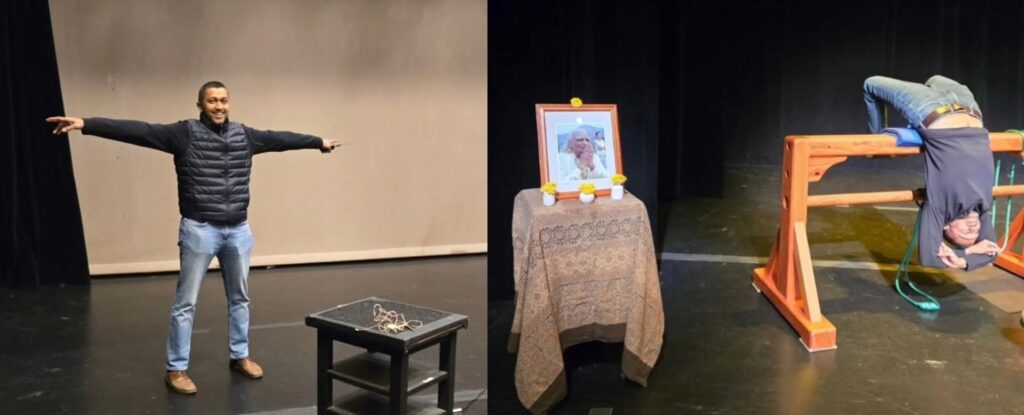
After two and a half hours of trying to master Vrischikasana, Raya sat against a wall, exhausted and frustrated. The pose was eluding him. Later, as he accompanied B.K.S. Iyengar to his house, he said, “Guruji, it’s impossible.” Asked what was impossible, he answered, “This practice.”
Guruji laughed. Raya left without an explanation.
That afternoon, in the library, his teacher handed him a copy of Light on Yoga. Inside was an inscription: “Dear Raya, Yoga is a hard art to master. But it is possible. With love, B.K.S. Iyengar.”
Years later, on September 15, 2026, Raya told this story at the Cultch in Vancouver. The occasion marked 50 years of the B.K.S. Iyengar Yoga Association in Vancouver and 60 years of Light on Yoga. For Raya, the book still carried the memory of that afternoon and of Guruji’s words: that practice is not just repetition but exploration of body, mind, breath, and thoughts. Yoga is a way of life.
A Familiar Pose Opens Up
The week began with open practices with Raya at Deb’s Mount Pleasant studio. On September 14, Raya took participants through several variations of Utthita Trikonasana. A foot against the wall, a hand holding a rope, a change in support, distributing efforts in a conscious direction, and each giving practitioners something different to notice.
He compared the connection through the body to a Wi-Fi network. The back foot was the router. Could the hip relay the signal? Could the shoulder? Was the whole body receiving it? Then came chocolate: coffee, orange peel, sea salt, and various cocoa percentages. Trikonasana had its own range of flavours.
Raya also spoke about leaving enough quiet for understanding to arise. Recalling Prashant Iyengar’s teaching, he wondered whether a continuous flow of external instructions can occupy all our attention; we need space to notice something for ourselves, allowing practice to generate new questions and a path for it to evolve.
A Morning Alongside the Teacher
The following day brought another open practice in Vancouver. Jayne Lloyd-Jones shared her experience: “I was lucky enough to attend the open practice with Raya on Tuesday, September 15. I even caught an early floatplane from Salt Spring Island for this special occasion, slipping into the room with seconds to spare. I was thrilled that Raya led us through different ways to practise: having us move quickly through a collection of hamstring-stretching poses (we did quite a few), or turning a pose on its head, then on its side, to appreciate its features (balasana, pavanamuktasana, malasana). We practised quietly on our own for the next 90 minutes, with one eye on Raya and his steadfast restorative sequence. All at once, he invited us to lunch with him, and off we went to enjoy a relaxed meal with a senior teacher from Pune. What a joy.”
The People Who Made It Possible
At the Cultch that evening, Claudia MacDonald recalled the small group that founded the association in 1976. Originally called the Light on Yoga Association, it later took B.K.S. Iyengar’s name at his request.
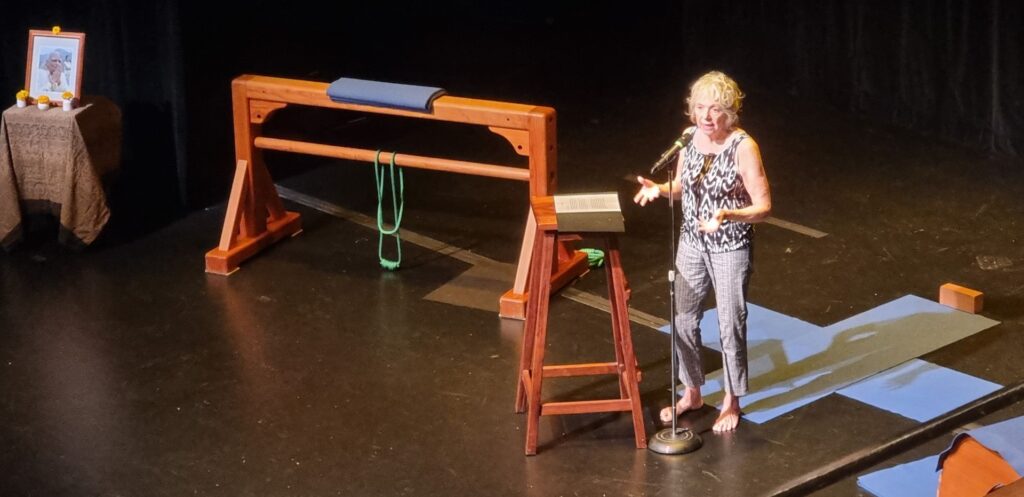
Claudia paid particular tribute to Maureen and Bruce Carruthers. Maureen brought Iyengar yoga to Vancouver and taught many of its long-standing teachers, and together, they helped maintain the keen connection with Pune.
Claudia also acknowledged the work that keeps a community going between major events: workshops, teacher support, the website, and financial and organizational responsibilities. These tasks are arranged by people whose efforts usually remain behind the scenes.
Introducing Raya, she recalled watching him assist Geeta Iyengar with quiet, gentle attention. With humour, she then cautioned those attending the intensive: they should not expect that particular quiet Raya to be conducting the conference.
Learning How to Practise
Raya’s account of his younger years gave the evening a more personal turn. He spoke about personal trials and tribulations that pursued him.
In January 1999, Guruji stopped him after a class and asked whether he practised. Raya answered by listing the classes he attended. Guruji asked again. Then came the question Raya had been struggling with himself: “What are you doing with your life?”
When Raya admitted that he did not know how to practise, Guruji promised to teach him.
It took time. Regular practice could still be bewildering, and the philosophical opening of Light on Yoga initially made little sense to him. He decided to turn to the photographs and tried things out. Gradually, he became more comfortable with himself. Years later, he returned to education and eventually completed postgraduate studies in philosophy.
Louie Ettling thinks the Live Demonstration was a unique experience: “It was not a typical yoga performance in which maximum asana skill might be on display. It was, for me, a sincerely felt demonstration of how yoga can shape consciousness and life’s path for an individual.”
Jayne Lloyd-Jones recalled the evening: “Raya told the story of his life being saved by Guruji, who recognized a powerful spirit trapped in the body of a teen who hated school and had failed his exams. Raya’s vulnerability and honesty were humbling. His practice was effortless. The evening was inspirational.”
Raya described how his relationship with practice had changed: “Practice was no longer to be done. It was happening organically. Practice became my compass to navigate.”
The Book in Motion
The personal story continued through the demonstration. Raya moved through asanas while discussing their placement in Light on Yoga, their relationships, and the possibilities of moving from one to another. He described the yoga journey from Tadasana to Savasana as a river flowing from mountain to ocean, passing through many landscapes of different asana families.
There was a story along the way, including his reluctance to attempt arm balances. His legs were too long, he had told Guruji, and his torso too short. The teacher found ways to help him work with those proportions by using props. That support of props offered a way to approach an action, investigate it, learn and gradually master a pose.
Worth mentioning was a great question: we need to figure out how to draw ourselves in. How do we draw ourselves towards ourselves? When we practice, where is Pratyahara (the 5th limb of Ashtanga yoga: withdrawal of the senses and mind from the external objects)?
Raya ended with Yoga Mudrasana, and while holding his feet and lifting up, he recalled the first sutra of the second chapter: Tapas, which is tenacity; Svadhyaya, which is self-study; and Ishvara Pranidhana, which is surrendering to God. This final asana was offered as a tribute to Guruji, Light on Yoga, and everyone gathered.
The following morning, participants would stand on their own mats. There would be plenty to attempt, and, as Raya had made clear, plenty to ask.
About the Author
Andrei is a former corporate executive with 25 years in emerging markets and a dedicated Iyengar Yoga practitioner since 2012. As an apprentice teacher, he continues to learn through steady practice and observation. He is the founder of MomentumSoul Yoga Solutions, developing a structured digital platform for thoughtful, methodical Iyengar yoga self-practice rooted in precision and clarity.