Equanimity: Reflections on a Workshop with Brian Hogencamp
by Andrei Rybkin
Some workshops stay with you not because of one dramatic moment, but because of the quality of attention they awaken. The recent Equanimity workshop with senior Iyengar Yoga teacher Brian Hogencamp was that kind of experience: steady, thoughtful, demanding, and deeply human.
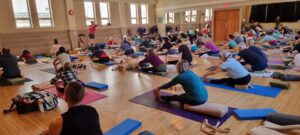
Hosted by the Iyengar Yoga Association of Vancouver, the workshop unfolded over three days, feeling carefully shaped and generously held. The first part of Day One was for teachers and apprentices, while the latter Friday session and the full program on Saturday and Sunday opened the space to the practitioner community. What developed over the weekend was a study of asana and pranayama as well as a living reminder of how Iyengar Yoga can support everyday life.
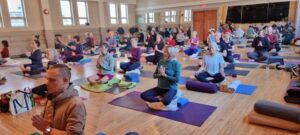
Each day began with the Invocation. Brian invited us into a subtle inquiry: Can you hear your own voice from outside in? Can you hear the voices of others from outside in? Can you also hear the vibration of your own voice from the inside out? Sung together in a full room, several dozen voices sounded like one; it relentlessly penetrated the (thin or thick) armour we carry during our everyday lives and created a sense of unity and depth. It was inspiring to hear so many voices together, and to be part of that sound.
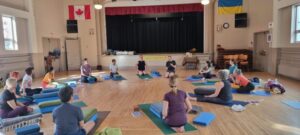
The profound practice we had, with an emphasis on what is visible to what is felt, was a central thread throughout the weekend. The theme of equanimity was introduced broadly as a yogic principle that shapes how we meet life, relate to others, and remain balanced, observant, and compassionate in the face of things as they are.
Brian’s teaching carried both precision and warmth. He has decades of practice and teaching behind him, so his clarity, steadiness, and evident wish to help students inquire more deeply paved the way for students to embrace the wisdom he shared.
Examples? Let’s recall Tadasana we started from, which became an exploration of weight distribution and the spreading of weight through the feet. From there, standing asanas developed the study further through gravity, direction, extension, and expansion. We were reminded again and again to observe the breath carefully: to keep it stable, to maintain a steady inner circuit, to let the breath support concentration rather than become disturbed by effort.
One of the important principles emphasized was that, in Iyengar Yoga, we do not distort the body’s natural structures. Each joint has its own integrity, its own appropriate movement, its own logic. This is essential not only for safety, but for truthfulness in practice. Over years of proper work, the body becomes more open and responsive through alignment, patience, and understanding.
A major step in yoga, and one that this workshop highlighted beautifully, is the movement from listening to objective instructions toward developing the subjective intelligence to carry them out fully. At first, we simply hear and try to follow. Later, something more refined begins to awaken: the ability to sense, discriminate, adjust, and participate inwardly in the pose. That shift teaches us to become less reactive, less mechanical, and more awake – in practicing as well as in everyday life.
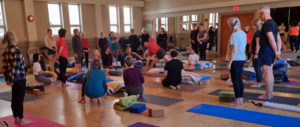
Day One included a particularly interesting exploration of the interrelationship between postures. Brian showed, for example, how qualities in Anantasana can clarify understanding of Utthita Trikonasana, especially through the organization of the ribs, the breath’s action, and the pose’s inner quality. This teaching method was especially valuable because it revealed that asanas speak to one another, and understanding in one place can illuminate another.
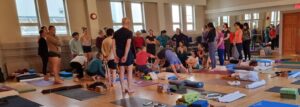
Day Two was devoted largely to asana and pranayama. In the Iyengar tradition, pranayama is first learned through sensitivity developed in asana. That principle became tangible during the workshop. Breath awareness was considered part of the posture’s intelligence. Here, we had the theoretical side of the workshop, which was very helpful in explaining Patanjali’s Ashtanga yoga and its eight limbs. This gave the workshop a broader context, as yoga is a discipline and an integral path involving moral conduct, the body, breath, mind, inward evolution, and an intrinsic journey towards the Seer within. Day Three then focused on inversions, continuing the inquiry into balance, observation, steadiness, and inner space.
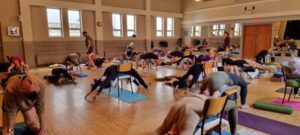
Another strong dimension of the weekend was the atmosphere itself. Whenever possible, participants were welcomed in a circle, which immediately changed the tone of the room for relationship, observation, questions, and shared learning. Brian’s answers and comments were often profound, helping reach a deeper understanding, and value came from the combination of practical instruction and thoughtful explanation. Brian often uses the word “lovely,” and somehow that simple word reflects something real in his approach: exact without being dry and serious without becoming heavy.
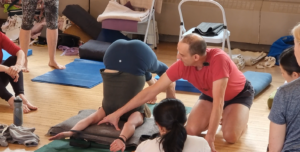
Every session concluded with Savasana. After sustained effort and attention, that quiet ending felt earned, bringing a deep sense of restoration and completion.
The role of the Iyengar Yoga Association of Vancouver and its volunteers also deserves real recognition. Events like this require care, outreach, coordination, and service. The workshop’s welcoming environment clearly reflected that work. The contributions of those who provided props (blankets, straps, platforms, bolsters) were also important. In Iyengar Yoga, props expand access, support precision and progress, enhance understanding of particular subtitles and overall experience.
Above all, this workshop offered a reminder that yoga practice, when we cultivate balance, steadiness, discernment, breath awareness, and patience, helps us respond to everyday life with its difficulties, how we relate to others, and carry ourselves through change.
One quotation from B.K.S. Iyengar feels especially fitting here: “In asana … the pose first brings the inner balance and harmony, but in the end it is merely the outer expression of the inner harmony.” That truth could have been felt through bold, meaningful trials that aligned outer action with inner order. And we did our best to align.
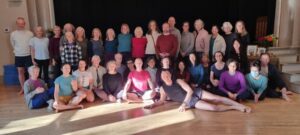
That may be why the workshop left such a strong impression. It was informative, inspiring, and quietly transformative. It showed, once again, that the ancient wisdom of yoga is passed on through consistent practice, precise instruction, sincere questioning, and a community willing to gather in that spirit together.
About the Author
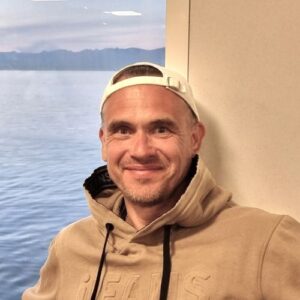
Andrei is a former corporate executive with 25 years in emerging markets and a dedicated Iyengar Yoga practitioner since 2012. As an apprentice teacher, he continues to learn through steady practice and observation. He is the founder of MomentumSoul Yoga Solutions, developing a structured digital platform for thoughtful, methodical Iyengar yoga self-practice rooted in precision and clarity.